Industrial Decarbonization Network’s Monthly News Round-Up [April 2026]
Add bookmark
Welcome to this month's Industrial Decarbonization Network Monthly News Round‑Up for April.
Each week, we highlight the latest developments, shaping methane management and mitigation, ESG reporting, regulatory compliance, sustainability, and low‑carbon innovation across the industrial landscape. This new monthly summary brings those key updates together in one place, offering a clear view of the trends, announcements, and insights that defined the past month.
We know that, as leaders in the oil and gas sector, your time is stretched, and in such a fast‑moving industry, it's easy to miss key developments. From policy shifts and technology developments to project milestones, emerging best practices and industry collaboration; this monthly news round‑up captures the stories most relevant to operators, decision‑makers, and sustainability leaders, helping you stay informed without adding to your workload. Our aim is to provide a concise, practical overview that supports your work and keeps you connected to the rapidly evolving decarbonization landscape.
Governance and Stakeholder Influence:
[March 23, 2026] Following their meeting in Houston at CERAWeek 2026, OGCI CEOs reaffirmed a clear direction to 2030, focused on continued, measurable progress. CEOs from Aramco, BP, Chevron, CNPC, Eni S.p.A, Equinor, Exxon Mobil, Occidental, Petrobras, Repsol, Shell, TotalEnergies, released a joint statement, after the CEOs' meeting in Houston, spotlighting the measurable progress made by the members. [Source: OGCI]
Key takeaways:
- They reported that upstream methane emissions were down by 63% and routine flaring was down by 72%. From this, they have laid strong foundations for the next chapter: an action-oriented agenda through 2030.
- They also emphasized their continued commitment to pursuing emissions reduction progress, despite global uncertainty around regulations, and the current geopolitical instability.
- While energy demand rises and energy security and affordability are on the decline, the CEOs reaffirmed the necessity to reduce emissions and scale up low-carbon solutions to create a sustainable, secure and reliable energy system.
[April 14, 2026] In a joint letter sent on April 13, 2026, more than 70 energy and industrial companies, trade associations, and 17 Members of the European Parliament have called on EU Energy Ministers and the European Commission to activate a "stop-the-clock" mechanism on the Methane Regulation, warning that its current timeline and requirements are unworkable. While backing methane emissions reduction, the signatories argue that missing standards, verification systems and regulatory infrastructure could force companies into de facto non-compliance by 2027, risking supply disruptions, higher energy costs, and reduced competitiveness across Europe. [Source: LinkedIn]
Key takeaways:
- Companies warn that compliance obligations take effect before essential standards, verifiers, and authorities are in place.
- The regulation carries penalties of up to 20% of annual turnover from 2027, despite unresolved implementation gaps.
- Industry groups argue large volumes of oil and gas could be excluded from EU markets, threatening energy security and affordability.
- Signatories call for targeted amendments, including a revised timeline, pragmatic MRV requirements, and legally workable penalties.
However, the Clean Air Task Force (CATF) has suggested that the EUMR leverages Europe's position as a global leader in tackling emissions while supporting energy security and competitiveness. CATF argues that the EUMR "does not restrict fuels from entering the EU" but instead applies proportionate penalties, noting that global gas markets are heading towards oversupply rather than scarcity. [Source: Clean Air Task Force]
Methane Mitigation and Climate Strategy:
[April 1, 2026] In April, the Africa Policy Research Institute (APRI) released an analysis investigating how Nigeria can transform methane emissions, which is currently a major climate and economic liability for Nigeria, into a valuable national asset by capturing and commercializing wasted gas from oil and gas operations, positioning methane mitigation as both a climate solution and an economic development strategy. [Source: Africa Policy Research Institute]
Key takeaways:
- Nigeria wastes an estimated 250–300 million standard cubic feet of gas per day, equivalent to USD 1.2–2.5 billion annually, largely due to flaring, venting, leaks, and abandoned wells.
- Methane emissions present a dual opportunity: cutting a potent climate pollutant while improving energy access, public health, and job creation.
- Stronger regulation, improved measurement, and private sector investment are identified as critical enablers for turning methane mitigation into a scalable economic opportunity.
Policy and Regulatory Developments:
[April 6, 2026] The EPA finalized revisions to the OOOOb/c portions of the Clean Air Act. While the rule remains in effect, key aspects have been amended to ease implementation challenges. According to the EPA, this final ruling will "save $2.5 billion while producing the cleanest energy in the world." [Source: EPA.Gov]
The major change to OOOOb/c is that temporary flaring has been extended to 72 hours from 24 hours. This is specifically for troubleshooting and repairs, granting additional time when site access is limited by: severe weather, personnel shortages, or supply chain constraints. [Source: Alliance Technical Group]
Additional changes include:
- Operators no longer need to perform routine Net Heating Value (NHV) sampling for flares or enclosed combustion devices (ECDs).
- Associated gas sources will be subject to the same monitoring framework as other facilities.
- Sampling demonstrations can serve as an alternative to continuous monitoring for all air-assisted and steam-assisted flares and ECDs.
Climate Policy Advocacy:
[April 21, 2026] A coalition of international NGOs has urged the European Commission to fully implement the EU Methane Regulation (EUMR), warning against delays or dilution driven by energy security concerns. They argue that robust methane transparency in oil and gas supply chains strengthens, not weakens Europe's long-term energy security. [Source: Environmental Defense Fund]
Key takeaways:
- NGOs stress the importance of strict monitoring, reporting, and verification (MRV) for O+G imports.
- The EUMR is framed as a security and market stability tool, not just a climate policy.
- Calls come amid debate over flexibility and enforcement of methane rules for imported gas.
- Methane transparency is highlighted as critical for comparing suppliers and managing supply-chain risks. It is described as a "pillar of EU energy security".
Data Automation and Technology Developments:
[April 22, 2026] Daphne Technology announced a CHF 15 million investment led by London-based investor Taranis, with support from Shell Ventures and Trafigura, to accelerate deployment of its methane abatement system that targets methane slip from natural gas compressor engines. The funding will support US manufacturing, additional field trials, and wider commercial rollout as operators face tighter global market pressures and emissions management expectations. [Source: Clean Tech Alps]
Key takeaways:
- Designed to target methane slip from natural gas compressor stations in midstream and upstream operations. Methane slip can account for over half of methane emissions from these assets.
- The backing from major oil and gas operators such as Shell signals growing commercial confidence in methane abatement technologies despite federal-level rollbacks to emissions reporting programs. This demonstrates the growing recognition within the industry of the business case behind robust methane management strategies.
Industrial Decarbonization Network's 'Featured Insight of the Month':
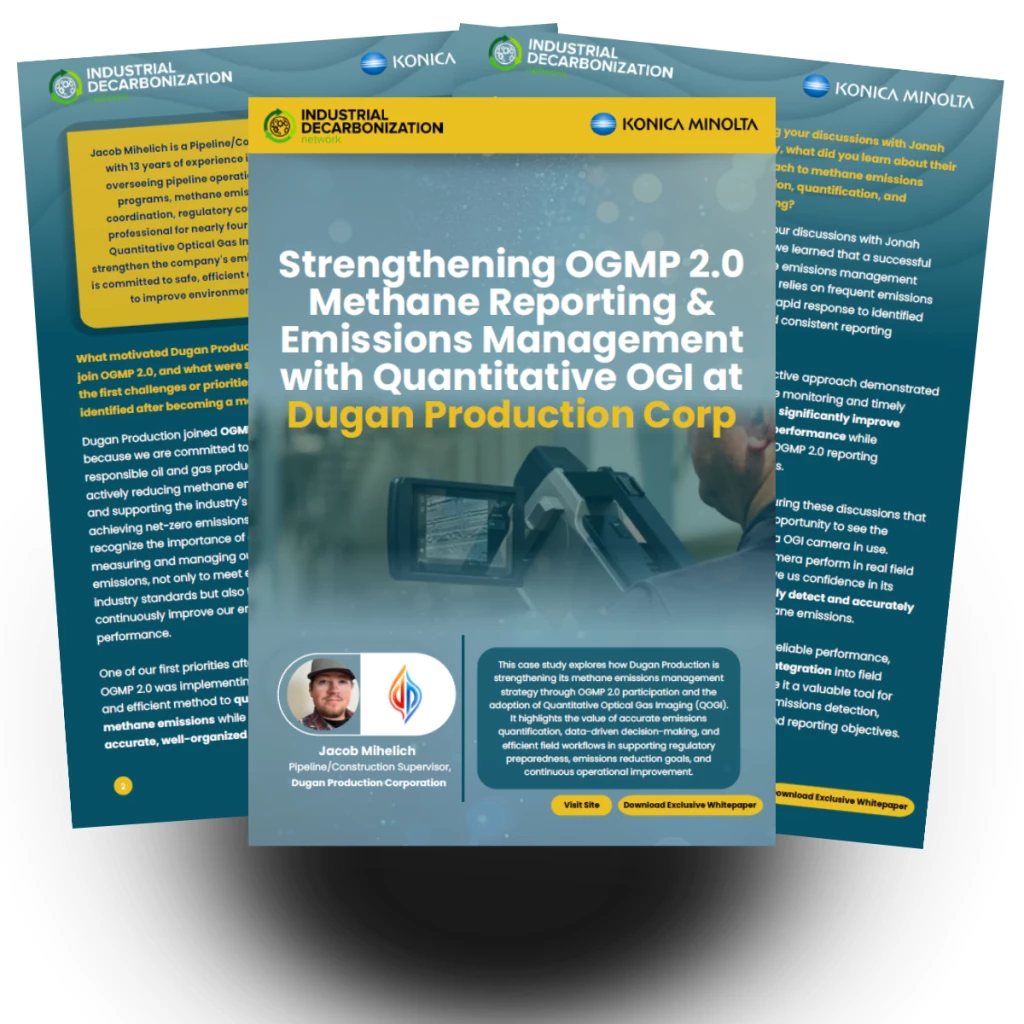
In case you missed it, Konica Minolta has released a new whitepaper published on the Industrial Decarbonization Network, exploring the design philosophy behind the GMP03 Reliable-Quantitative Optical Gas Imaging (R-QOGI) camera, and what it takes to achieve decision ready methane quantification in real-world field conditions.
As expectations around methane performance, transparency, and data credibility continue to rise, operators are increasingly challenged to deliver measurements that stand up to scrutiny, not just detect leaks. This whitepaper reframes quantitative OGI from a single-snapshot measurements into a time-series evaluation problem, addressing the realities of unstable wind, plume deformation, and variable sensitivity that often undermine confidence in field results.
The whitepaper breaks down how GMP03's time-series approach, representative emission values, and built-in reliability indicators deliver more credible, decision ready quantification, so teams know when results can be trusted and when re-measurement is needed. Download the whitepaper to see how reliable QOGI is redefining confidence in methane measurement and setting a new bar for field-based quantification.
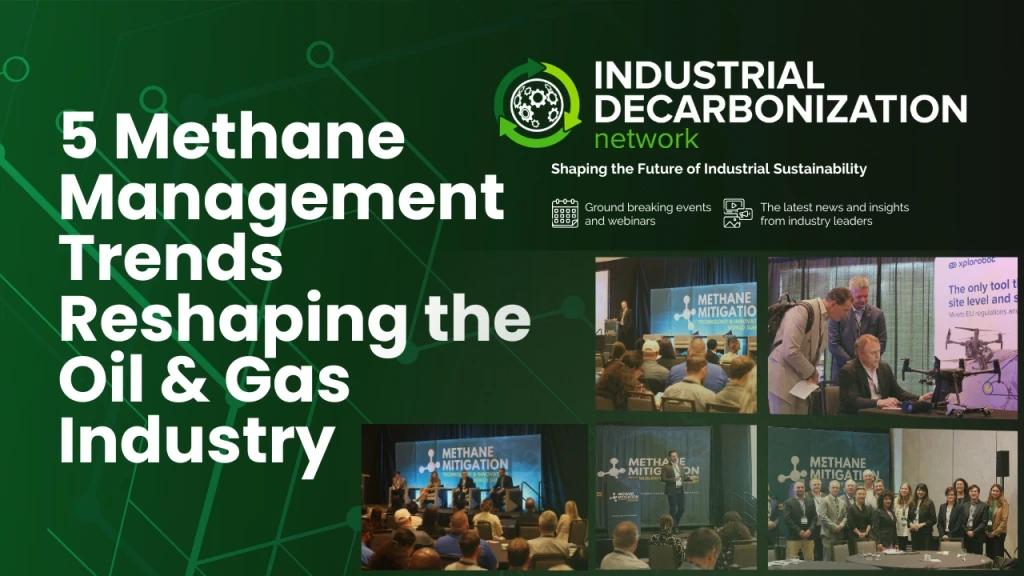
Methane Mitigation: Technology & Innovation World Summit | June 2-4, 2026 | The Woodlands, Texas
Award's Deadline Extension!
Due to popular demand, we're extending the submission deadline for the Methane Mitigation Excellence Awards to May 15. We've already received some fantastic submissions, and with this being a particularly busy time of year, we want to ensure everyone has the opportunity to showcase the outstanding projects and initiatives being delivered across the industry.
We look forward to seeing more of your entries.
Unlock the guidelines here!
Or submit your application here!
Stay connected with the Industrial Decarbonization Network as we continue to track the technologies, strategies, and standards shaping the global pathway to industrial net‑zero.