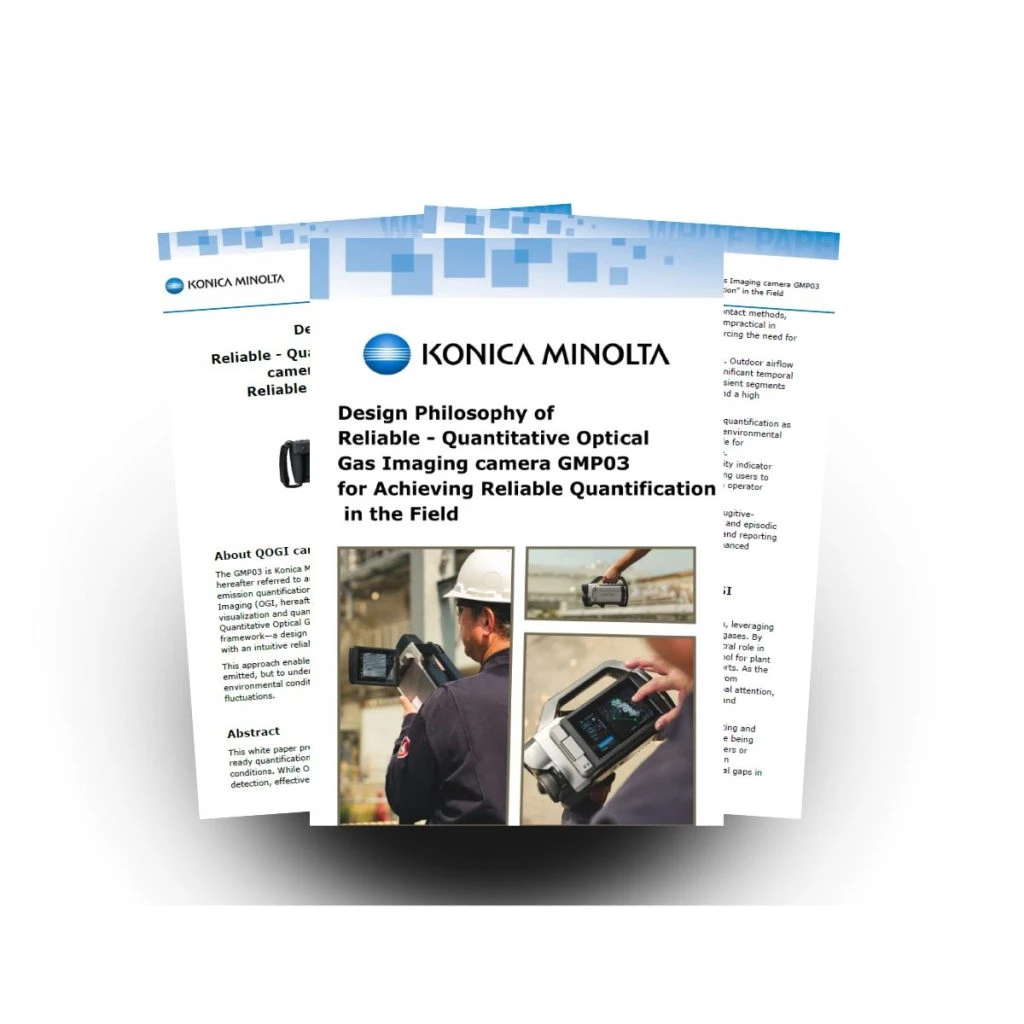
Design Philosophy of Reliable – Quantitative Optical Gas Imaging Camera GMP03 for Achieving Reliable Quantification in the Field
A design philosophy focused on reliable quantitative gas measurement in the field
Add bookmark
As expectations around methane performance continue to rise, operators are facing growing pressure to produce quantified, credible emissions data while supporting improvements in OPEX and asset reliability. Heightened stakeholder scrutiny and growing demands for transparency are accelerating this shift, even as regulatory standards continue to fluctuate at the state and federal levels. Yet field based QOGI measurements are often disrupted by unstable wind, variable sensitivity, and plume deformations, making it difficult to determine when results can be trusted to meet these growing expectations.
To address these credibility challenges, Konica Minolta introduces the design philosophy behind the R‑QOGI camera GMP03, a new approach that reframes methane quantification as a time‑series evaluation problem, rather than a single‑moment measurement, enabling more accurate and transparent data.
In this white paper, Konica Minolta outlines how GMP03 was engineered to deliver decision‑ready quantification in the field, using representative emission values and reliability indicators to reduce operator subjectivity and improve confidence in results.
Download the white paper to explore:
- Why conventional QOGI struggles under real‑world field conditions
- How time‑series evaluation improves stability and accuracy
- The role of representative values in mitigating wind‑driven variability
- How reliability indicators help users decide whether results can be used, or whether re-shooting is advisable
- Validation results demonstrating improved performance over simple averaging
Download your copy to understand how R‑QOGI is redefining what "reliable quantification" means for methane measurement in the field.