Industrial Decarbonization Network’s Monthly News Round-Up [March 2026]
Add bookmark
Welcome to this month's Industrial Decarbonization Network Monthly News Round‑Up for March.
Each week, we highlight the latest developments, shaping methane management and mitigation, ESG reporting, regulatory compliance, sustainability, and low‑carbon innovation across the industrial landscape. This new monthly summary brings those key updates together in one place, offering a clear view of the trends, announcements, and insights that defined the past month.
We know that, as leaders in the oil and gas sector, your time is stretched, and in such a fast‑moving industry, it's easy to miss key developments. From policy shifts and technology developments to project milestones, emerging best practices and industry collaboration, this monthly news round‑up captures the stories most relevant to operators, decision‑makers, and sustainability leaders, helping you stay informed without adding to your workload. We aim to provide a concise, practical overview that supports your work and keeps you connected to the rapidly evolving decarbonization landscape.
Global Certification and Verification Pathways:
[February 24, 2026] Tourmaline Oil Corporation recently announced that the organization has achieved Grade A certification under MiQ's methane measurement, reporting, and verification standard, making it the first Canadian producer to achieve this standard. The process delivered independently verified reporting across onshore production, gathering and boosting, and gas processing, representing a global first in integrated, system‑wide methane certification.
MiQ notes the achievement as a major step towards greater transparency and accountability in global gas markets, as buyers increasingly demand independently verified emissions data. By achieving Grade A certification, Tourmaline has positioned itself as a trusted, low‑emissions supplier, reinforcing Canada's leadership as markets, regulators and investors push for credible methane performance evidence. [1]
Data Automation and Tech Developments:
[March 7, 2026] Uganda has deployed drone-based methane monitoring as it prepares for commercial oil production in the Albertine Graben, aiming to detect and repair methane leaks early across wells, pipelines and processing facilities. Owor Domisiano, Environment Officer at the Petroleum Authority of Uganda (PAU) emphasized the importance of this real-time data and monitoring of hard-to-access areas. [2]
Key takeaways:
- The initiative focuses on the Albertine region, where difficult terrain makes traditional, ground-based methane monitoring costly and less effective.
- PAU is coupling drone technology with other abatement strategies, such as LDAR and infrared cameras/sensors, to more urgently identify and repair leaks.
- Through these technology investments, Domisiano is hoping to signal to the international community that Uganda is committed to aligning with global climate goals.
Emissions Management:
[March 17, 2026] Colombia's second-largest O+G producer, GeoPark, announced that it has met its five‑year decarbonization goal, cutting the carbon intensity of its oil and gas operations by 35% and reducing methane emissions by 86% between 2020 and 2025 through an intensive LDAR program. Independent firm InsightM1 confirmed zero significant methane leaks across GeoPark's Colombian operations in late 2025. The company says the progress was driven by energy efficiency measures and a strengthened methane management program. Alongside emissions reductions, the initiatives also improved operational reliability and generated significant cost savings of roughly $70 million, underscoring the business case for methane mitigation and low‑carbon operations in the upstream sector. [3]
[March 17, 2026] A new satellite analysis from UCLA's Stop Methane Project (SMP), based on data from Carbon Mapper, revealed the world's largest methane leaks of 2025. This analysis spotlights the advancements in these satellite tools, which can now pinpoint exactly which companies are non-compliant with global climate commitments.
Key takeaways:
- The analysis found 4,400 significant plumes in 2025, each emitting more than 100 kg/hour.
- Turkmenistan was responsible for 15 of the top 25 worst methane leaks from oil and gas facilities in 2025.
- Significant "mega-leaks" were also detected in the United States, Iran, and Venezuela, often linked to state-owned or large corporate oil and gas infrastructure.
- While global and domestic regulations will require these plumes to be addressed, researchers at SMP have emphasized the financial benefits of cutting emissions, noting that captured gas can be sold or reused, helping to offset the costs of tackling large-scale emissions. [4]
Policy and Regulatory Developments:
[March 23, 2026] The U.S. government publicly urged the EU to soften its methane regulations on oil and gas imports, warning that strict enforcement could undermine Europe's energy security amid Iran-related global gas supply disruptions. The US ambassador to the EU, Andrew Puzder, argued that "if Europe wants to have affordable energy, it's going to need to reduce the regulatory requirements and restrictions that it has in place". [5]
- While Europe doesn't buy much gas directly from the Middle East, the U.S. now supplies nearly two‑thirds of Europe's LNG, giving Washington leverage amid tighter global supplies.
- The dispute highlights rising tension between climate standards and energy security.
- From 2027, methane monitoring, reporting, and verification requirements will apply to imports under the EU Methane Regulation, and by 2030, the EU plans to impose financial penalties of roughly 20% on imports with high methane intensity.
Concerns about the regulation's impact are not limited to external suppliers. German gas importer Uniper has warned that EU methane rules could constrain Europe's energy supplies, as the Chief Executive, Michael Lewis, stated that "we're adding another layer of challenge to sourcing gas for Europe", while speaking at the CERAWeek energy conference in Houston. [6]
These concerns are echoed in an early March Wood Mackenzie report, commissioned by the International Association of Oil & Gas Producers (IOGP). Using scenario modelling, the report concludes that up to 43% of EU gas imports and 87% of crude oil imports could be deemed non-compliant by 2027 if the regulation is enforced under current standards, largely due to the absence of equivalent methane reporting systems in exporting regions. The analysis also suggests potential price increases of 24% for gasoline and 16% for diesel. [7]
However, a contrasting analysis by Rystad Energy, commissioned by the Environmental Defense Fund, suggests that global LNG supply is expected to grow by around 4% annually, resulting in an oversupply between 2028 and 2032. According to this study, the projected surplus would give the EU greater scope to demand higher transparency and environmental performance from suppliers without jeopardising access to gas. [8]
[March 25, 2026] The Government of Alberta and the Government of Canada announced an Agreement in Principle to align provincial and federal methane regulations, allowing Alberta to regulate oil and gas methane emissions if it delivers equivalent results to federal rules. This builds on the November 2025 Canada-Alberta Memorandum of Understanding. The deal aims to cut methane emissions 75% below 2014 levels by 2035, while reducing regulatory duplication and providing long-term certainty to industry. [9]
Key takeaways:
- Federal methane regulations would be replaced in Alberta once a final equivalency agreement is in place, provided provincial rules achieve the same environmental outcomes.
- A draft equivalency agreement will undergo a 60-day public consultation, include independent third-party verification, and is intended to take effect by January 1, 2027, pending final approval.
- This agreement will provide regulatory certainty while supporting innovation and emissions reductions across the sector.
Industrial Decarbonization Network's 'Featured Insight of the Month':
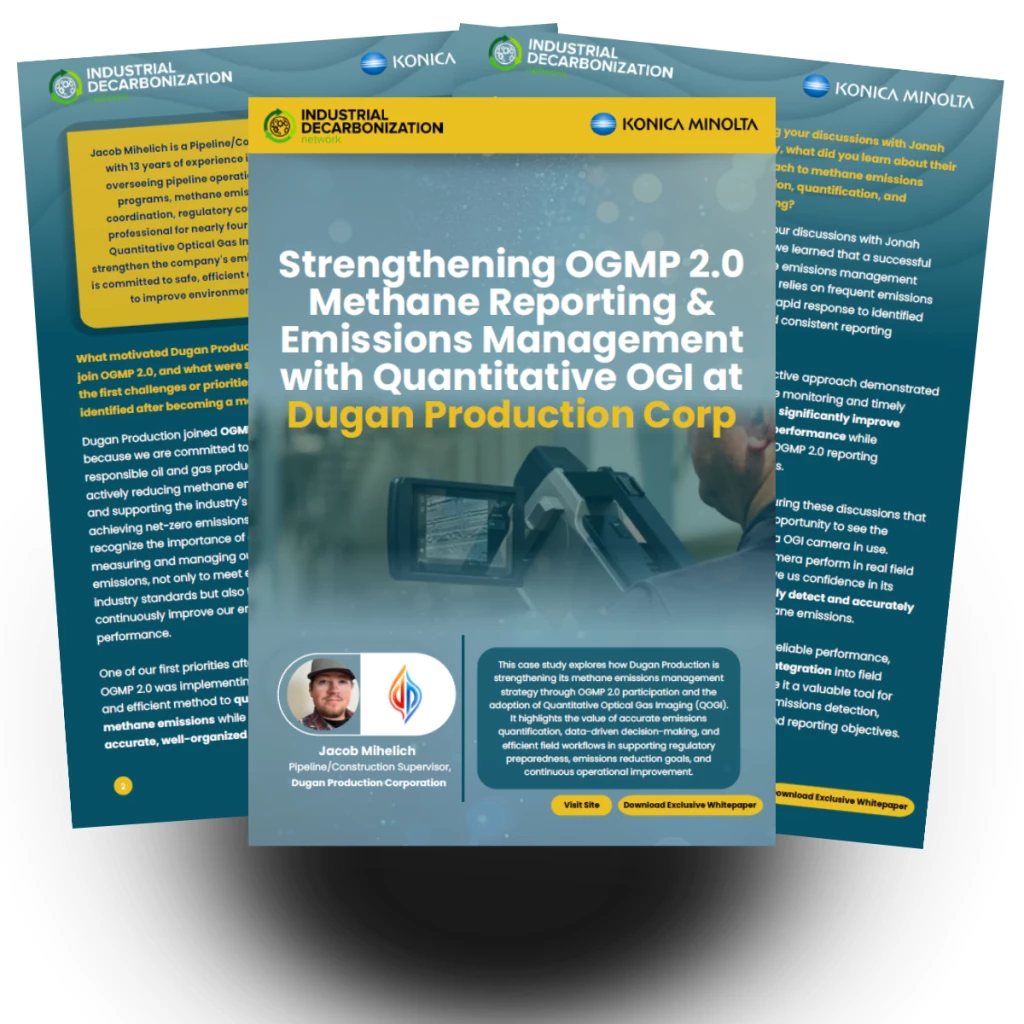
In case you missed it, we recently launched a case study-led report titled "Building the Business Case for Voluntary Methane Management: Driving Resilience and Operational Excellence". This report features exclusive insights from Charles Crews – Executive Vice President & Chief Operating Officer – Southern Star Central Gas Pipeline, Maggi Young – Director, Environmental Policy & Sustainability – Expand Energy Corporation, and Keith Shoemaker – Chief Commercial Officer – Coastal Bend LNG.
As market expectations rise and scrutiny around methane emissions increases, voluntary methane management is shifting from a compliance issue to a strategic driver of resilience and commercial advantage. Companies across the value chain are showing that smarter detection, early‑stage engineering choices, and integrated methane strategies can reduce outages, enhance OPEX, and strengthen asset reliability. These three industry leaders share how methane‑aligned technologies, predictive analytics, and performance‑based operational practices are helping their teams capture more product, prevent costly failures, and advantageously position themselves for tightening global expectations.
Methane Mitigation: Technology & Innovation World Summit | June 2-4, 2026 | The Woodlands, Texas:
Join us at The Woodlands Waterway Marriott
Located just 20 miles from George Bush Intercontinental Airport and 30 miles from downtown Houston, this venue offers an unbeatable location steps from Market Street shopping, upscale dining, and entertainment, with a skybridge to The Cynthia Woods Mitchell Pavilion.
Stay connected with the Industrial Decarbonization Network as we continue to track the technologies, strategies, and standards shaping the global pathway to industrial net‑zero.
References:
[1] MiQ, "Canada's Largest Natural Gas Producer Becomes the First Company to Certify Its Integrated Natural Gas Production System," February 25, 2026, https://miq.org/canadas-largest-natural-gas-producer-becomes-the-first-company-to-certify-its-integrated-natural-gas-production-system/
[2] The Independent, "Drones Tackle Methane Emissions in Oil‑Rich Albertine," March 7, 2026, https://www.independent.co.ug/drones-tackle-methane-emissions-in-oil-rich-albertine/
[3] GeoPark, "GeoPark alcanza su meta de descarbonización de cinco años," March 17, 2026, https://www.geo-park.com/es/news/geopark-alcanza-su-meta-de-descarbonizacion-de-cinco-anos/
[4] Damian Carrington, "Revealed: the World's Worst Mega‑Leaks of Methane Driving Global Heating," The Guardian, March 17, 2026, https://www.theguardian.com/environment/2026/mar/17/revealed-world-worst-methane-leaks-global-heating
[5] Energy Connects, "US Presses EU to Ease Methane Rules, Warns of Energy Supply Risk," March 23, 2026, https://www.energyconnects.com/news/renewables/2026/march/us-presses-eu-to-ease-methane-rules-warns-of-energy-supply-risk/
[6] Financial Times, "US Presses EU to Ease Methane Rules, Warning of Energy Supply Risks," March 2026, https://www.ft.com/content/b8de67ac-b245-4a01-8211-af56d4f3a21a
[7] Wood Mackenzie, "EU Methane Emissions Regulation Study: Analysis of Market Impacts," March 10, 2026, https://www.woodmac.com/news/opinion/eu-methane-emissions-regulation-analysis-of-market-impacts/
[8] Environmental Defense Fund, "EU Methane Regulation Emerges as Strategic Tool for Energy Security," December 10, 2025, https://www.edf.org/media/eu-methane-regulation-emerges-strategic-tool-energy-security
[9] Prime Minister of Canada, "Canada and Alberta Reach Agreement‑in‑Principle on Methane Equivalency," March 25, 2026, https://www.pm.gc.ca/en/news/news-releases/2026/03/25/canada-and-alberta-reach-agreement-principle-methane-equivalency