5 Methane Management Trends Reshaping the Oil and Gas Industry
Key insights from industry leaders on methane reporting, AI, operational optimisation, market access and the future of methane management.
Add bookmark
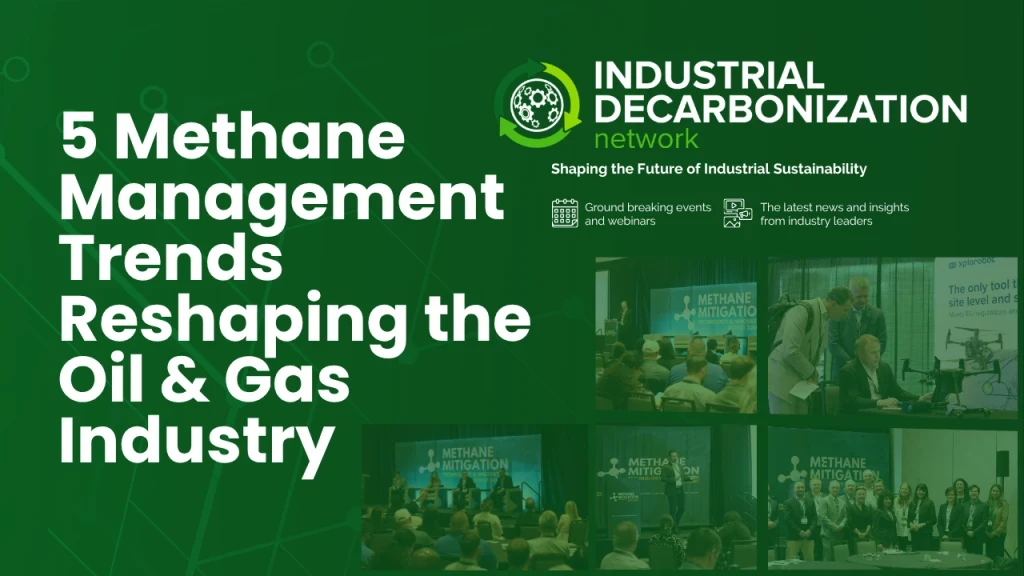
If one theme defined this year's Methane Mitigation Technology & Innovation World Summit, it was the evolution of methane management from a compliance obligation to a source of competitive advantage.
Across three days of discussion with operators, technology providers, investors, policymakers and industry leaders, it became clear that the organisations setting the pace are no longer viewing methane programmes simply through the lens of emissions reduction. Instead, they are using methane management to improve operational performance, strengthen commercial resilience, secure market access and build investor confidence.
This shift comes at a pivotal moment for the industry. While policy and regulatory uncertainty continues to shape decision-making in many regions, the momentum behind methane mitigation has not slowed. Rather, it has matured. Organisations are making increasingly commercial decisions about where to invest, how to prioritise technology, and how to build programmes that deliver measurable business value regardless of the regulatory environment.
What also stood out was the breadth of leadership driving this progress. From independent producers and supermajors to national oil companies, LNG exporters, pipeline operators and technology innovators, there was broad recognition that methane performance is becoming a defining indicator of operational excellence. Whether through improving asset reliability, meeting the expectations of customers and global markets, or demonstrating resilience to investors and lenders, methane management is increasingly influencing competitive position across the energy value chain.
The following article captures the key themes, insights and practical takeaways that emerged from the conversations in Houston. Together, they provide a snapshot of an industry that is moving beyond asking why methane matters, and is instead focused on how to unlock its strategic value.
1. The commercial value of methane management is accelerating
While regulation remains an important catalyst, discussions throughout the summit demonstrated that the business case for methane mitigation is becoming increasingly market-led.
Organisations are responding not only to compliance requirements, but to growing commercial signals from customers, investors and buyers that methane performance is becoming a key differentiator.
Perhaps the strongest example came from the continued emergence of low-carbon gas as a commercial product. Meta's recent Request for Proposals (RFP) for low-carbon natural gas generation was cited repeatedly as evidence that major energy buyers are beginning to incorporate emissions performance into procurement decisions. Similarly, industrial buyers and LNG customers are placing increasing value on independently verified low-carbon gas, with one speaker noting, "If you aren't certifying, we aren't buying."
The EU Methane Regulation is also extending its influence beyond Europe. Although questions remain around implementation, exporters increasingly recognise that demonstrating robust methane measurement and reporting will be critical to maintaining access to European markets, further reinforcing the commercial value of credible methane management programmes.
The message from industry was clear: methane performance is no longer viewed solely as a cost of compliance. It is increasingly becoming a commercial capability that supports market access, customer relationships and long-term competitive positioning.
2. The jury is still out on AI, but expectations are high
As methane programmes continue to mature, operators are increasingly turning their attention to a new challenge: how to extract value from the growing volumes of emissions data being generated across their assets. As a result, artificial intelligence emerged as one of the summit's most talked-about topics.
Many organisations are now exploring how AI can be applied within emissions management platforms to reconcile data from multiple detection technologies, automate reporting, identify anomalies, prioritise leak investigations and support faster operational decision-making. As monitoring technologies continue to scale, there is broad recognition that new tools will be needed to transform data into actionable insights.
At the same time, discussions reflected a healthy degree of scepticism around the maturity of AI within the context of methane management. While interest is growing rapidly, operators repeatedly emphasised that the value of AI will ultimately depend on the quality of the underlying data, the robustness of measurement programmes and its integration into existing operational workflows. Several speakers also questioned whether many of today's AI applications represent meaningful innovation or simply incremental improvements to existing analytics capabilities.
The consensus was one of cautious optimism. AI has the potential to become an important enabler of more efficient methane management, but the industry is still determining where it can deliver measurable operational value. For now, the focus remains on practical use cases that help operators make faster, better-informed decisions, rather than adopting AI for its own sake.
3. The future of methane reporting is entering a period of reinvention
The potential rollback of the Greenhouse Gas Reporting Program (GHGRP) and Subpart W was one of the most debated topics of the summit, but discussions quickly moved beyond the regulatory implications. Instead, operators focused on a more fundamental question: what should credible methane reporting look like if the existing federal framework changes?
For many organisations, the loss of Subpart W would remove an important baseline for emissions reporting and verification. However, rather than signalling the end of robust reporting, many operators indicated they intend to continue applying Subpart W methodologies, maintain corporate greenhouse gas inventories and invest in third-party assurance regardless of federal requirements. Several argued that credible reporting has become a business imperative driven by customers, investors and export markets, not solely by regulation.
The discussion also highlighted growing interest in voluntary frameworks and measurement-informed approaches. Speakers pointed to third-party verification, reconciliation methodologies and initiatives such as OGMP 2.0 as mechanisms that could strengthen confidence in reported emissions while providing greater flexibility than a prescriptive regulatory framework.
Importantly, many participants viewed the current uncertainty as an opportunity rather than simply a setback. Rather than recreating the reporting framework of the past, there was broad discussion around designing a future system that better reflects advances in measurement technologies, incorporates third-party assurance and allows operators to demonstrate methane performance with greater credibility. The consensus was that while the reporting landscape may evolve, demand for transparent, independently verified methane data is only expected to increase.
4. The next wave of methane reductions will come from operational optimisation
For many of the industry's most mature methane programmes, the era of "quick wins" is coming to an end. Operators shared that years of LDAR programmes, equipment upgrades and targeted leak repairs have already captured many of the most accessible abatement opportunities. The focus is now shifting towards more complex, system-level interventions capable of delivering the next step change in emissions reductions.
Rather than concentrating solely on leaking components, organisations are increasingly evaluating how assets themselves can operate more efficiently. Discussions highlighted initiatives such as optimising power generation across facilities, electrifying equipment, exploring shared power infrastructure, redesigning platform operations and integrating alternative fuels into operations. These projects typically require greater capital investment and longer implementation timelines, but also offer the potential for significantly greater emissions reductions while improving operational performance.
At the same time, speakers emphasised that effective abatement is becoming increasingly data-driven. The challenge is no longer simply collecting emissions data, but using it to prioritise investments, identify the highest-impact opportunities and ensure capital is deployed where it delivers the greatest operational and environmental return. As one operator explained, improving equipment inventories, refining emissions accounting and integrating multiple monitoring datasets has enabled far more targeted decision-making than was possible only a few years ago.
The discussion also reinforced that there is no single blueprint for success. While some operators are focused on establishing the foundational systems needed to build robust methane programmes, others are optimising mature programmes and pursuing increasingly sophisticated abatement strategies. As a result, methane management is becoming less about implementing a standard set of best practices and more about tailoring investment decisions to asset maturity, operational priorities and commercial objectives.
5. Methane Strategy is now a Business-wide Priority which requires Strong Cross-functional Collaboration
Methane is no longer siloed within environmental or sustainability teams. Effective implementation requires alignment across operations, engineering, legal, procurement, and executive leadership. A key strategic question emerging: Will operators build in-house capability or outsource? As LDAR obligations increase, operators are reassessing internal capacity, operating models, and CAPEX vs OPEX investment strategies.
Conclusion
The conversations throughout the summit highlighted an industry that is entering a new phase of methane management maturity. While regulatory developments continue to influence decision-making, organisations are increasingly focused on how methane management can deliver measurable business value through operational efficiency, stronger market positioning, improved emissions performance and enhanced stakeholder confidence. The direction of travel is clear: methane is no longer viewed solely as an environmental responsibility, but as a strategic business capability that is shaping competitiveness across the oil and gas value chain.
Download the Full Post-Event Report:
These five trends represent just a snapshot of the discussions that took place in Houston. For a deeper dive into the strategies, technologies, market developments and operator insights shaping the future of methane management, download the full 2026 Methane Mitigation Technology & Innovation World Summit Post-Event Report.
Inside, you'll find additional insights from industry leaders, key session takeaways, emerging technology trends and practical guidance for building effective methane management programmes in an evolving global landscape.