Welcome to the Methane Mitigation Europe Summit
Europe's Flagship Summit Dedicated to Oil & Gas Methane Reduction
Interview
EU Methane Regulation at a Crossroads: Balancing Ambition with Security of Supply - Insights from IOGP
In this episode of Methane Talks, we’re joined once again by Emils Lagzdins, Senior Policy Officer at IOGP Europe, to assess the state of the EU Methane Regulation two years on.
This discussion comes at a pivotal moment, as effective implementation is now critical to ensuring the EUMR delivers on its ambitions, without leaving large parts of the industry non-compliant. In this conversation, we examine where progress is stalling, and the urgent actions required to ensure the regulation is effective while still safeguarding Europe’s energy supply.
Having spent several years working alongside EU institutions and industry stakeholders on legislative processes, including time within the European Commission’s Directorate-General for Energy, Emils bring a unique blend of policy insight and member company-level perspectives on the methane regulation.
In this episode, we unpack:
- Year Two of the EUMR: what has progressed, what remains missing, and why many operators feel they are “operating in the dark.”
- The critical gap between measurement and abatement: which regulatory rules actually drive emissions reductions.
- Importer requirements: a pivotal element of the regulation, with current timelines risking large portions of global supply being non‑compliant by 2027.
- Why targeted amendments may now be unavoidable: what a pragmatic, risk‑based approach to methane mitigation should look like.
- Standardisation challenges: the status of CEN/ISO work, why prescriptiveness is limiting flexibility, and when the industry can realistically expect clarity.
- As the EU seeks to balance climate ambition with security of supply, Emils provides one of the clearest and most technically grounded assessments available on the policy and what the path forward may look like.
- Whether you're an operator, policymaker, technology provider, or stakeholder, this is a must‑listen conversation.
Insight from a Competent Authority Perspective: Implementing the EU Methane Regulation at a National Level
As the EU Methane Regulation (EUMR) moves toward full enforcement, gaining insight from a competent authority is invaluable. These bodies are responsible for implementation, shaping enforcement strategies, coordinating with the industry, and ensuring compliance across complex networks.
Having just passed the February 5, 2026 deadline for source-level methane measurement and MRV reporting and with more deadlines to come in 2027, operators face mounting pressure to align with evolving requirements. To help you navigate this landscape, we spoke with Jens Knochen, Policy Advisor for Emission Control at the State Office for Mining, Energy and Geology (LBEG), to answer some critical questions:
- How can competent authorities ensure uniform enforcement across diverse sectors?
- What role will innovation and technology play in meeting leak detection and venting reduction requirements?
- How can collaboration between regulators and industry drive consistency and efficiency?
Download the full interview to explore:
- Germany’s roadmap for implementing the EU Methane Regulation Key priorities and sector-specific challenges for competent authorities
- Practical strategies for reducing uncertainty and leveraging innovation
- Access the report now to gain actionable insights from the regulator’s perspective and strengthen your compliance strategy.
Access the report to gain actionable insights from the regulator’s perspective and strengthen your compliance strategy.
The Complexities of the EU Methane Regulation: Challenge or Misconception?
As the EU Methane Regulation (EUMR) moves closer to full enforcement, operators across Europe and beyond are grappling with the complexities caused by a lack of clear guidance and technical complexity. While the regulation aims to set a level playing field and accelerate climate progress, its practical implementation raises critical questions: Can technology keep pace with evolving regulations and operational demands? What does technical best practice look like in achieving compliance without excessive cost or complexity?
Having just passed the February 5th, 2026 deadline to submit MRV reports containing quantification of source-level methane emissions and with more deadlines to come in 2027, and uncertainty surrounding monitoring frequency, data reconciliation, and importer provisions, pressure is mounting. To help you navigate these challenges, we spoke with Bettina Knudsen, COO and Co-Founder of Explicit, a pioneer in drone-based methane detection, to uncover candid insights on:
- Balancing ambition and practicality: Why proportionality across emissions sources matters and how dynamic monitoring can make compliance more viable
- Managing measurement uncertainty: The realities of methane quantification and what technical best practice looks like as technology evolves
- Why standardisation matters: Building integrity and confidence in a rapidly innovating market
Download the full interview to explore:
- The biggest compliance hurdles operators face under the EUMR
- Proven strategies for reducing uncertainty and improving monitoring workflows
- How innovation, automation, and proportionality can transform methane mitigation efforts
Access the report to gain practical guidance on meeting regulatory requirements, optimising your monitoring strategy, and driving real emissions reduction.
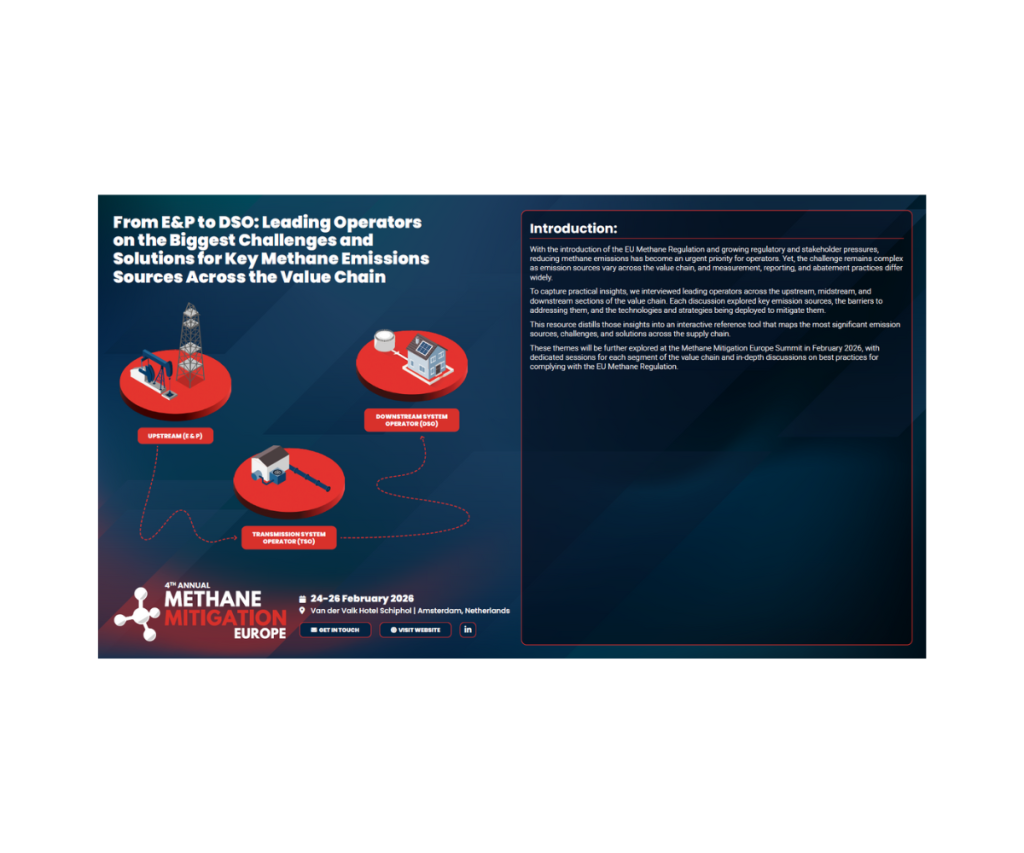
Leading Operators on the Biggest Challenges and Solutions for Key Methane Emissions Sources Across the Value Chain
After speaking with industry leaders, one key lesson stands out; “While many operators face similar challenges, each site is unique. You can’t simply copy and paste solutions from one location to another.”
With regulatory deadlines moving closer as well as growing stakeholder pressures, reducing methane emissions has become an urgent priority. To ensure technical best-practice and to stay ahead of regulatory or stakeholder scrutiny, whether you operate within the exploration and production, transmission, or distribution of oil and gas, it is crucial that you are aware of the pre-set paths to efficient emissions reduction, at each level of the value chain.
As the industry is racing against the clock to prepare for the EU MR, we sought to uncover practical, on-the-ground insights and provide you with proven strategies from peers within your unique operational setting. We spoke with expert leaders from across the upstream, transmission and distribution segments of the value chain; Bart Wauterickz, Managing Director at XP Upgreen, François Spitaels, Environment Manager at Fluxys, and Vinsents Makaris, Head of Corporate Governance and Compliance at JSC Gaso. These leaders shared candid perspectives on their most significant emission sources, the barriers to tackling them, and the innovative solutions being deployed to drive real results.
Download the infographic to explore:
- The key challenges that leading operators face in mitigating methane emissions across the value chain
- The technologies and strategies that are delivering measurable abatement success
- The lessons learned from successful emissions reduction efforts by XP Upgreen, Fluxys, and JSC Gaso, and their expectations for the future
Download this interactive infographic now to see where you can make the biggest impact on methane reduction, understand the challenges across the value chain, and identify the strategies being leveraged by your peers to efficiently reduce emissions.

Preparing for the EU 2025 LDAR and Reporting Deadlines
As the EU makes important strides to curb methane emissions, the recently enacted EU 2024/1787 regulation outlines stringent guidelines for operators across Europe. By May 5, 2025, operators must submit a Leak Detection and Repair (LDAR) program detailing the measurement technologies, timelines for measurements, and the planned methodologies. Additionally, in 2025, operators are required to complete Type 2 measurements for all assets, alongside annual LDAR and Monitoring, Reporting, and Verification (MRV) reports.
We spoke with Brandon Locke, Europe Policy Manager for Methane, Clean Air Task Force, and Cristina Lopez, Research and Development (R&D) Engineer, GRTgaz, to better understand the regulatory requirements and the challenges that lie ahead for Europe's oil and gas operators.
This interview will provide you with insights into:
- Navigating these regulatory changes as the first reporting deadline in May 2025 approaches
- Employing best practices in training and cost management to align with ambitions EU targets
- Leveraging technology to meet regulatory, voluntary, and company-specific goals

Sustainable Investments and the Role of ‘Financial Institutions' in the Oil and Gas Industry
In an increasingly environmentally conscious world, the finance sector is undergoing a transformative shift, driven by the need for responsible investments. As the global community grapples with the urgent challenges of climate change, the role of 'Financial Institutions' has taken center stage in steering the course towards more sustainable global economies.
David Carlin, Head of Risk at the United Nations Environment Programme Finance Initiative (UNEP FI) plays a pivotal role in assessing the risks and impacts of climate change on organizations and their clients as well as helping institutions prepare for climate-associated challenges to ensure a smooth transition towards sustainability.
David shares his insights on the evolving landscape of finance and the role financial institutions like the UNEP FI play in driving environmentally responsible investments.

OGMP 2.0 and the Global Imperative to Mitigate Methane Emissions
In 2014, the United Nations Environment Program launched the Oil and Gas Methane Partnership (OGMP) to tackle the challenge of methane emissions in that industry. Since then, additional organizations and reporting initiatives have sprung up to add to the growing body of knowledge about the effects of methane emissions and methods to reduce them.
One of the key initiatives is OGMP 2.0 – “OGMP 2.0 is, now, the most comprehensive and advanced measurement-based reporting initiative in the world, with almost 100 member companies.” It counts many oil and gas companies, such as BP, Shell, and Equinor, among its members.
In this interview, Giulia Ferrini, OGMP 2.0 Program Manager, discusses the changing landscape for methane mitigation, the key areas companies looking to mitigate methane emissions should focus on, how member companies can get more out of their relationship with OGMP 2.0, and exciting updates to the framework.
Download your copy of this interview today and catch up with OGMP 2.0 at the Methane Mitigation Europe Summit.

Preparing for New EU Regulations on Methane Emissions
The European Commission has been working on a new set of rules on methane reduction in the energy sector. The proposal is expected to introduce new requirements on measurement, reporting and verification of methane emissions, restrictions on flaring and venting, and an increase in transparency on methane emissions associated with fossil fuel imports.
How can European oil and gas operators prepare for the new legislation?
Ahead of Methane Mitigation Europe, we caught up with Conference Chair and Speaker, Andris Piebalgs, Professor at the European University Institute and former European Energy Commissioner, about what the new proposals will mean for the energy industry, where they stand today, and how to prepare for these proposals.
Download your copy of the interview today.
In Partnership With:

QUESTIONS?
Address: IQPC Ltd, 129 Wilton Road,
London SW1V 1JZ
Telephone: +44 (0) 113 210 042
Fax: 44 (0) 207 368 9301
Email: enquire@iqpc.co.uk

©2026 IQPC. All rights reserved.